
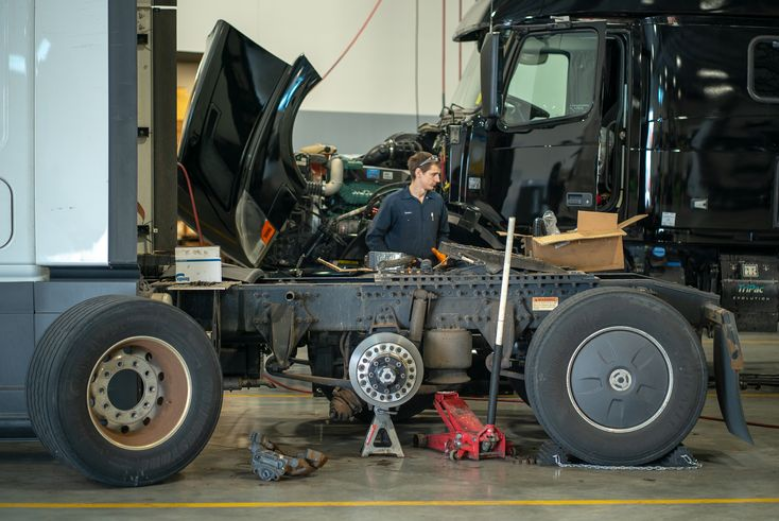
Modern heavy trucks rely on air brakes working in step with EBS to deliver consistent, predictable stopping power. When leaks creep in, slack adjusters drift, or EBS sensors go out of range, wheels no longer share the load equally. That shows up as longer stopping distances, hot hubs, rapid lining wear and compliance headaches. This practical guide explains how the system works, what fails, and how AMCS maintains brake performance across single units and full combinations.
Why Air Brake Health Determines Fleet Safety
Air brakes convert stored compressor energy into precise clamping force at each wheel. The system must retain pressure, respond quickly, and apply force evenly from axle to axle. EBS adds electronic control to modulate pressure and coordinate truck and trailer braking in milliseconds. Any weakness in supply, timing or balance sacrifices stopping consistency and heats components unnecessarily.
Typical South African Failure Patterns
- Chronic micro-leaks that never trip alarms but keep compressors cycling and dryers saturated
- Slack adjusters that haven’t been verified since shoe changes, causing side-to-side imbalance
- Water-logged air from neglected dryers, corroding valves and relay bodies
- Wheel-speed sensor gaps and dirty tone rings that upset EBS stability logic
- Trailer wiring and earth faults that cause intermittent EBS communication drops
System Overview: From Compressor to Shoes
- Compressor & Governor: Builds system pressure and controls cut-in/cut-out.
- Air Dryer: Removes moisture and oil mist; a tired cartridge lets water into valves.
- Reservoirs & Check Valves: Provide staged supply and isolation.
- Foot/Brake Valve & Relays: Translate driver demand into wheel-end pressure quickly.
- Slack Adjusters & Foundation Brakes: Convert push-rod movement into shoe force.
- EBS Hardware: ECU, modulators, pressure sensors, wheel-speed sensors and ABS rings coordinate the whole system.
Step-by-Step Leak Testing That Catches the Small Stuff
- Stabilise Pressure: Engine off, full system charged.
- Static Test: Record pressure loss over 2 minutes at rest.
- Applied Test: Hold service brake; measure loss with and without trailer connected.
- Bubble & Tone Tests: Soapy solution on unions, chambers, relay vents; listen for valve seat hiss.
- Circuit Isolation: Close tank drains and isolate circuits to pinpoint the offender.
- Compressor Health: Verify cut-in/cut-out, build time, and dryer purge cycle.
Pro tip: A small constant loss at a relay exhaust can be valve contamination from wet air. Dryer service often fixes “mystery” leaks.
Slack Adjusters: Manual vs Automatic, and Why “Set & Forget” Fails
- Manual Adjusters: Require calibrated adjustment to specified push-rod travel. Over-tightening drags linings; under-tightening lengthens stroke.
- Automatic Adjusters (ASA): Shouldn’t be manually wound regularly. If they aren’t maintaining stroke, diagnose foundation issues first (worn cams, seized rollers, bent return springs).
- Verification: With a gauge, measure and record push-rod travel per wheel. Compare left/right on the same axle and across axles to confirm balance.
Correct Setup Procedure (Condensed)
- Inspect shoes, rollers, pins, return springs; replace in axle sets.
- Verify cam bushings and anchor pins.
- Set push-rod free play to spec; apply brakes several times; re-measure.
- Log final travel and note any wheel that trends toward max stroke between services.
Brake Balance, Timing and Trailer Dynamics
Even application matters as much as absolute force. Balance issues often live in the details:
- Valve & Relay Location: Long, small-bore lines delay signal; relocate or upsize where practical.
- Load-Sensing Valves: Confirm settings after suspension work; mis-set valves under-brake loaded axles.
- Trailer Matching: Check truck and trailer control timings and pressures; standardise components on multi-trailer fleets to avoid “mismatched” responses.
- Lining Compatibility: Mixed friction materials across axles can change heat profiles and wear rates.
EBS Diagnostics Without the Guesswork
- Wheel-Speed Sensors: Verify air gaps, ring cleanliness and continuity.
- Modulators & Pressure Sensors: Run guided tests; compare commanded vs measured pressure.
- Fault Trees: Address primary faults first; clear and road test; re-scan to catch intermittent issues.
- Harness Checks: Trailer sockets, earth continuity and pin tension are common culprits in intermittent EBS drops.
- Performance Validation: Conduct controlled stops and record brake temperatures to confirm balance.
Preventative Service Intervals That Actually Work
- Every Service: Reservoir drains, dryer purge check, quick leak test, visual hose inspection.
- Quarterly: Full static/applied leak test, push-rod travel logging, valve function test.
- Semi-Annual: Dryer cartridge replacement (or sooner for high-moisture routes), governor verification, detailed EBS scan and data export.
- Post-Lining Replacement: Mandatory slack adjuster verification and EBS stability check.
What You Can Do Between Services
- Train drivers to report longer pedal travel, persistent compressor cycling, or ABS lamps that flicker over bumps.
- Standardise foundation brake components across fleets where possible.
- Keep a single-page brake balance log for each unit and trailer, updated after every check.
How AMCS Keeps Your Trucks Stopping Straight
- On-site testing: Leak tests, push-rod measurements and valve checks conducted at your depot to minimise downtime.
- Workshop repairs: Dryer overhauls, valve replacements, foundation brake rebuilds and EBS fault resolution with OEM-level diagnostics.
- Documentation: You receive balance logs, EBS reports and service recommendations aligned to your routes and loads.
- Compliance & safety focus: We prioritise repeatable stopping performance and traceable records for audits.
Ready to improve stop consistency and reduce hot-hub failures?
Enquire today about air brake maintenance, EBS diagnostics and fleet-wide brake performance audits.